Airbrush Technique
Origin and history
Airbrush Technique in nail art originates from the broader use of airbrushing tools within the automotive and commercial illustration industries of the mid-20th century. The specific adaptation for nail enhancement began to gain documented traction within professional nail salons during the 1980s. Its development is closely tied to the evolution of specialized, low-pressure airbrush machines and the creation of nail-specific, highly pigmented acrylic paints. The technique was pioneered in the United States and Japan as nail technicians sought methods for achieving seamless gradients and detailed artwork unattainable with hand-painting. The availability of stencils and friskets designed for the small canvas of the nail further propelled its adoption in high-end nail artistry. This period established airbrushing as a distinct professional service within the salon industry, separate from conventional polish application.
What it is for
Airbrush Technique is primarily for creating smooth, gradient color transitions and highly detailed, photographic-quality artwork on nail enhancements. It serves to apply color and design with a level of uniformity and soft blending that is extremely difficult to replicate with a brush. The technique is used to achieve specific visual effects like ombré fades, realistic-looking skies, intricate lace patterns, and precise geometric designs. It functions as a method of pigment application within the broader nail enhancement system, compatible with substrates like acrylic, hard gel, and natural nails when properly prepared. Its purpose extends to efficient, layered application for complex multi-color designs in a commercial salon setting. The fine mist allows for building up color intensity gradually without the texture or bulk associated with multiple coats of traditional polish.
Airbrush Technique nail ideas
A classic application is a flawless ombré fade from cuticle to free edge, often using complementary colors like blush pink to white or navy to silver. Stencils can be employed to create crisp negative space designs, such as animal prints, Art Deco geometries, or delicate filigree patterns over a gradient base. The technique excels at producing realistic effects like marble veining, where multiple colors are sprayed and manipulated to mimic natural stone. Galaxy nails utilize layered sprays of deep purples, blues, and blacks, speckled with white for stars, to create a cosmic scene. Airbrushing can simulate the texture of denim or camouflage with precise, soft-edged color blocking. For a minimalist look, a soft airbrushed shadow at the nail's base or tips can add dimension to an otherwise clean enhancement.
Airbrush Technique nails
Airbrush Technique nails refer to the finished set where the primary or sole method of color and design application is an airbrush machine. These nails are characterized by their exceptionally smooth, matte-finish color application prior to top coating, devoid of brush strokes. The designs often exhibit a soft, diffused edge and a seamless blend between colors that appears almost photographic. The technique allows for complex, multi-layered artwork that is consistent across all ten nails, a hallmark of professional execution. The final cured result, when sealed with a top coat, is typically smooth to the touch and highly durable, similar to a gel polish finish. It is important to distinguish that the nail enhancement itself (e.g., acrylic, gel extension) is built separately; the airbrush is solely the decorative layer applied atop the prepared surface.
Overview
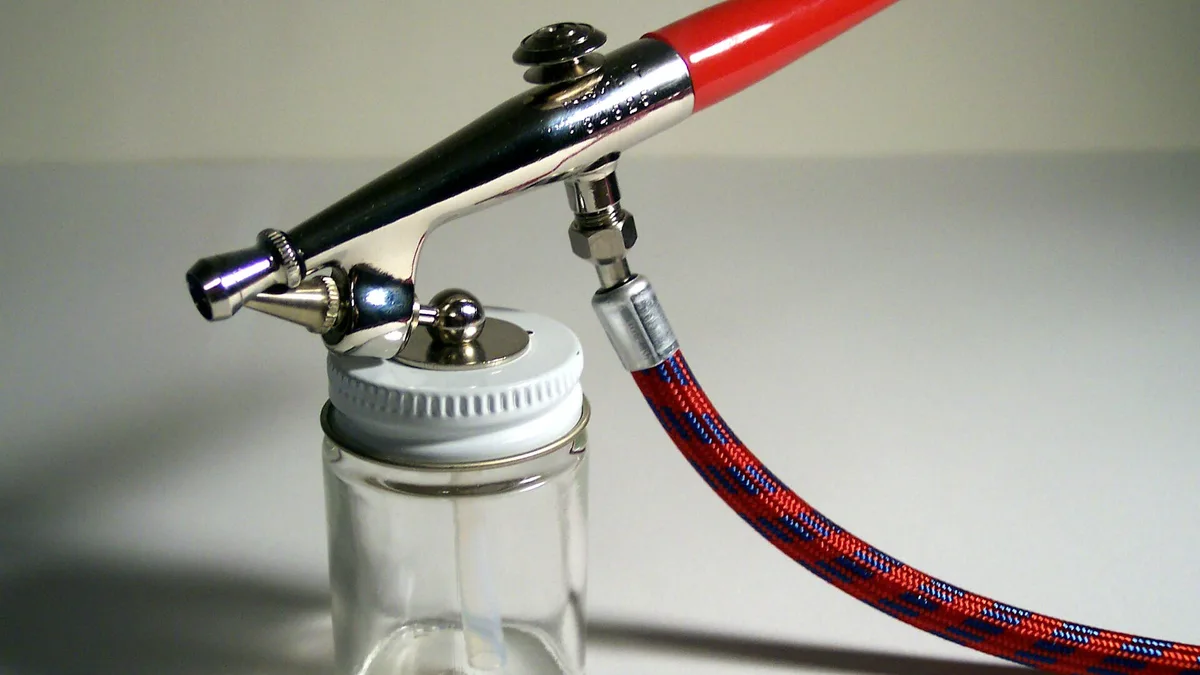
Airbrush Technique is a mechanized method of applying nail art using a small, handheld airbrush gun that atomizes liquid paint into a fine mist. It operates as a subsystem within the nail enhancement process, following the construction of the nail structure and preparation of the surface. The core components are the airbrush itself, a compressor for a controlled air supply, specialized airbrush paints or inks, and often stencils or masking materials. Mastery of the technique requires understanding paint consistency, air pressure control, distance from the nail, and trigger manipulation for line weight and spray density. It represents a significant investment in equipment and training compared to brush-based artistry, positioning it as a premium salon service. The result is distinct from other methods, offering efficiency for certain designs and a unique aesthetic of soft transitions and precise, repeatable detail.
What to know
Professional-grade equipment is essential; low-quality airbrushes clog frequently and produce inconsistent spray patterns, leading to flawed designs. The technique requires a dedicated, well-ventilated workspace as atomized paint particles become airborne and can contaminate other salon areas or be inhaled. Airbrush paints are formulated differently from standard nail polish and require specific thinner cleaners; using incorrect products will damage the equipment. A foundational skill in conventional nail enhancement is mandatory, as the airbrush decorates but does not build or repair the nail structure. Practice on practice wheels or plastic tips is crucial to develop control before working on a client, as errors cannot simply be wiped away like wet polish. The process often involves multiple steps of masking, spraying, drying, and sealing, which must be factored into service timing and pricing.
Common questions
A common question is whether airbrushing damages the natural nail, to which the answer is that the technique itself does not, but improper removal of the underlying enhancement or top coat can. Clients often ask how long the design lasts, which is equivalent to the wear of a standard gel polish manicure when properly applied and sealed with a top coat. Many inquire if it is possible to do at home, which is generally not recommended due to the cost, technical skill, and necessary ventilation required for professional equipment. A frequent concern is the safety of breathing the spray, underscoring the need for technician use of particulate respirators and effective salon ventilation systems. People ask if designs can be removed easily, which they cannot; removal requires soaking off the entire top coat and design layer like any other gel product. Technicians commonly question how to prevent clogging, which is managed through meticulous cleaning between color changes and using paints specifically designed for fine-nozzle airbrushes.
Pros and cons
The technique allows for efficient replication of complex designs across a full set, making it viable for salon time constraints. A major con is the high initial investment for reliable equipment and the steep learning curve; poor technique results in splotchy, uneven coverage and wasted product. Common mistakes include holding the airbrush too close, causing pooling and runs, or using paint that is too thick, leading to immediate clogging. Clients and technicians sometimes regret choosing it for very simple, single-color applications where the setup and cleaning time outweigh the benefit. The equipment requires diligent, immediate cleaning after every use; neglect leads to permanent clogging and costly repairs or replacement, a frequent point of failure for casual users.
Who it suits
This technique best suits experienced nail technicians who have mastered structural enhancements and seek to expand into premium, artistic services with a distinct marketable skill. It is ideal for clients who specifically desire soft, airbrushed aesthetic effects like ombrés, realistic textures, or detailed pictorials that are the technique's hallmark. The method suits high-volume salons or artists who offer predefined design menus, as stencils allow for relatively quick replication of popular patterns. It is less suited to technicians or hobbyists who prefer freehand painting or who work in spaces without adequate ventilation for aerosolized particles. The technique suits individuals who value consistency and precision across all nails and are willing to pay a premium for this level of finish. It is generally not recommended for those new to nail artistry, as the operational complexity can be overwhelming without foundational knowledge of nail systems and color theory.